Specials
Each building and each facade is unique. The requirements on their execution, function and performance have become more diverse than ever before. This requires special engineering disciplines, simulations and calculation tools, digital data handling as well as concepts and solutions for service and maintenance during the operational phase.
Specials
Each building and each facade is unique. The requirements on their execution, function and performance have become more diverse than ever before. This requires special engineering disciplines, simulations and calculation tools, digital data handling as well as concepts and solutions for service and maintenance during the operational phase.
Specials Services
The aim of Priedemann’s thermal-structural planning is to minimise heat losses and undesirable heat input through the exterior of the building and to avoid damage caused by weather conditions. The range of services includes identifying all influences and values relevant for the facade structure as well as the exact dimensioning and determination of the materials for the layer structure of the facade.
- Thermal insulation: On the basis of local and specific project requirements and after evaluation of the technical building plan, we determine the necessary values for thermal insulation in the summer and winter.
- Energy standards: We take into account which energy standards and objectives must be met – such as KfW requirements, low and passive house standards or requirements of green building labels such as LEED, BREAM or DGNB.
- Materiality: We calculate the necessary U-values and resulting insulation thicknesses, make specific material suggestions, give advice on the correct wall structure and determine the g-values taking into account the measures selected to provide protection from the sun.
- Overall energy performance: We determine the necessary values from building services and the facade to work out the overall energy performance of the building. An important component, especially in residential buildings, is the calculation of the transmission heat loss of the entire exterior of the building.
- Isothermal profile and thermal bridges: We analyse the isothermal profile within the planned or implemented construction, calculate 2 or 3 dimensional thermal bridges and give recommendations to avoid condensation forming
- Component construction with layer construction: Depending on the commission, we draw up a catalogue for the entire building or selected components, which shows the scale of each individual component in its layer structure and specifies the material qualities in order to give those involved in planning certainty about the structural-physical qualities of the planned construction.
- Advice throughout every phase: This is the basis on which we advise architects and builders, general contractors and facade manufacturers, whom we assist in all planning and implementation phases.
We provided this Service for:
- Calculating and adjusting noise level values: We determine the noise-level values that occur locally as the basis for planning the necessary noise protection and the required noise protection values for individual rooms, taking into account the planned use. We compare the values obtained with the legal and project-specific requirements.
- Determination of the requirements for the facade components: From this we can deduce the requirements for the facade components and recommend suitable constructions and material qualities. We take into account the flank transmission over adjacent components and spaces and influence the arrangement and design of the substructure, the choice of window and glazing types as well as the selection of materials and sensible arrangement of joins
- Ambient noise level: We determine the ambient noise level and reverberation times in the room and give recommendations on sound absorption and the distribution of sound-absorbing elements and surfaces.
- Preparation of sound- and noise protection reports: We prepare sound and noise protection reports as part of the approval process.
- Evaluation of internal emissions: We evaluate the emissions of technical installations and give recommendations for compliance with the prescribed noise level values.
- Sound pressure: We define the structural conditions for the maximum permissible sound pressure level in rooms where protection is required.
- Sound absorption: We calculate the sound-absorption surfaces required and propose suitable sound-absorbing materials and surfaces as well as their positioning within the framework of a spatial concept.
Improving the intelligibility of speech: We develop ways to make speech intelligible and to avoid disturbing echoes in the room. - Improving the intelligibility of speech: We develop ways to make speech intelligible and to avoid disturbing echoes in the room.
We provided this Service for:
Buildings, their functions and methods of construction and their technical systems are becoming increasingly complex. Standardised calculation methods are often no longer adequate to determine building physics values. Here Priedemann relies on various computer-based simulation tools. We feed our simulation programs with the planned overall concept consisting of building services, the building structure and the facades and climate data in order to determine the achievable comfort values according to ISO 7730 or the heating and cooling loads.
The absolute, relative (perceived) and maximum room air temperature or the maximum number of hours in which these values are exceeded are often the main factors.
To this end, particularly critical rooms in a building are identified and analysed so that recommendations can be made for further specific planning. When we need to analyze particularly complex systems or processes, we use a range of 3-dimensional flow simulations (CFD Computational Fluid Dynamics). For this purpose, we convert the given three-dimensional building structure into CFD-readable data sets and enter the energetic, building physics and weather data into the program. For example, statements on flow velocities, temperature distributions in the room air and on surfaces can be determined.
We also use CFD programs for the verification of smoke extraction scenarios as well as necessary or planned smoke extraction and post-flow cross-sections. Cross-sections or the number of conventionally determined smoke extraction openings can thus be optimised and often reduced.
We provided this Service for:

Saving fossil fuel, reducing operating costs, increasing efficiency.Around a third of the world’s primary energy is used to operate buildings. Fossil, non-renewable fuels are used for more than 80 percent of this, while the demand for energy is growing at the same time. Energy is usually generated in large central power plants, and the energy is provided via wasteful supply networks. Decentralized energy generation seems more than logical. In addition to solutions to use energy more efficiently and reduce consumption, renewable energy sources must increasingly be developed. Priedemann considers locally usable solar energy in particular to be one of the most sensible solutions.
- Both heat and electricity can be collected with today’s facade systems.
- With both forms of energy, all types of energy required in a building can now be adequately provided.
- Facade surfaces are often larger than roof surfaces: We can harness the potential of solar energy using suitable systems available on the market.
- While the residential sector mainly needs heating energy, the commercial sector mainly needs cooling energy and industry needs energy for processing.
- The highest demand for cooling occurs, when solar radiation is at its highest. With solar cooling systems we can use this inexhaustible source of energy, save fossil fuels, reduce operating costs and increase efficiency.
- We determine the energy demand, evaluate the potential on the basis of local weather data, the building location and orientation and, together with the specialists involved, develop concepts and solutions for energy generation integrated into the facade.
We provided this Service for:
Priedemann produces energy saving certificates based on the existing building data, which represent the most important energy consumption data and characteristic values in accordance with local legal requirements. For Germany we are also authorized to assess such evidence.
For completed projects or ongoing projects – depending on local regulations and the determination of specific building data – we can issue energy efficiency certificates that illustrate the energy consumption of the building as a whole, i.e. in the interaction of building services, facade and use.
We provided this Service for:
- Architectural 3D models are often created as surface or node models. We analyze this data and transform it into realistic volume models on the basis of which facade components can later be produced.
- We provide information on details that would pose special challenges during implementation or could not be built, e.g. if tested systems or approved products are not applicable, or connections would be so delicate that they could not absorb the loads.
- So that we can react flexibly to the different system environments, we are equipped with the current programs such as Rhino, Grasshopper, Archicad, Revit, AutoCad, Athena or Solid Works and are familiar with many other programs.
We provided this Service for:
The digital, 3-dimensional simulation of the complete building with all trades involved, including the design, construction and construction processes as well as building operation – that is the idea behind BIM. More and more clients and investors are relying on integrated planning as a BIM model. Priedemann has taken up this challenge.
A facade model designed by us is a complete parametric-digital representative of the facade. Views, sections and additional data can be generated from this information to help determine decision-relevant information and to optimize the manufacturing process of the facade. The data is programmed individually for each project, so that it can be adapted to the specific requirements of the project.
Before we enter a BIM environment, we agree the formats and communication standards for the exchange of data with the parties involved. These standards are specified, tested and confirmed during a kick-off meeting. In this way we ensure that all of the information can be incorporated in the main model right from the start. We know that starting a BIM project without these communication standards involves a considerable risk.
We know that planning is a living process accompanied by change. Parametric data models allow us to react flexibly to changing conditions or situations. Parametric planning can be an integral part of a BIM process or an independent part of planning and implementation. Using different 3D software, we design individual facade components, elements or entire assemblies and use them to generate CIM (computer integrated manufacturing) and DFM (design for manufacture) compatible data sets.
These data sets can be transferred to CNC data (Computer Numeric Control) for production. Parametric planning is an efficient and reliable tool for consistent planning and accuracy, especially for complex facade geometries – from design to manufacture and installation. Our parametric data models provide us with a reliable basis for tendering, awarding and implementation.
We provided this Service for:
As quickly as possible, as much as possible and all at the lowest possible cost, but with the agreed qualities and applicable standards. This is often the objective. Priedemann has long relied on the advantages of digital tools and computer-assisted procedures. This is how we keep the progressive automation of further production areas as well as the increasing complexity of machines and processes under control. AND we create and deliver the data sets to control these machines and processes.
We look at digital production on two levels, that of machines and their maintenance, and the level of the production process. We design the production and process level under the premise of achieving maximum efficiency. For this purpose, processes are simulated digitally and facades are modeled in 3D. We prepare the computer-based adaptation and implementation of the design to match the production conditions (Design For Manufacturability DFM). We generate suitable CAD data (Computer Aided Design), which we transfer into CNC data (Computer Numerical Control) for subsequent production.
The facade is the “face” of a building,a surface and a medium, which the building uses to communicate with its surroundings. The arrangement of open and closed surfaces, the materials used – all this reveals something about the interior life of a building and how it relates to its surroundings.
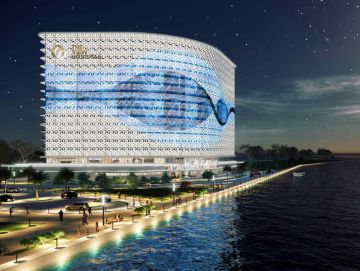
However, the metaphor of the “medium” can also be translated directly onto the facade by turning it into a “media facade”. Depending on the sharpness of detail and type of message, as well as the viewing distance, the facade surfaces differ in the size and number of pixels required. One of these pixels may be the size of a light-emitting diode or take up an entire facade or window element, depending on whether graphic animations, lifelike images, video sequences or texts are to be shown.
Priedemann plans all types of media facades and integrates them into the overall design. It is our aim that the media facade is part of the whole, including operation and maintenance, and is not reduced to the level of an appendage or a technical gimmick. For example, we develop concepts in which the energy needed to operate is generated by the facade itself. We take care of the necessary planning and performance data and create a feasible facade design. In the Facade-Lab area we develop transparent media facades together with industrial partners from the glass industry.
We provided this Service for:
Facades have to cleaned and maintained. What sounds trivial is a component of facade planning and maintenance, which ensures the long-term value of a project, so it should not be underestimated. Priedemann keeps operating costs low by making the logistics of maintenance and cleaning an integral part of the planning right from the start. This is not only about equipment for maintenance and cleaning, the type and design of the facade itself can make a decisive contribution. Facade solutions that do not take this into account during planning and construction make maintenance more expensive over the entire service life.
- Moving components: Facades today contain a large number of movable and electrical components. Individual components require regular maintenance. This needs to be taken into account right from the start.
- Glass: Glass can be damaged, replacing glass must be possible at any point with reasonable effort. Today, individual panes weigh several hundred kilos, floor-to-ceiling triple glazing weighs up to one ton and more. We plan the right solutions for this.
- Cleaning: Glass cleaning and the cleaning of horizontal surfaces are part of regular operating expenses. We provide simple, secure access with as little technical effort as possible. We make cleaning recommendations and create complete cleaning plans right up to the choice of cleaning agents and necessary intervals with which cleaning can be carried out most effectively.
- Facade development: We plan all facilities for the development of the facade areas, determine the loads of fall protection systems, walkways and access systems and consider the points of contact and passage through the facade to the building shell during planning.
We provided this Service for:
Depending on requirements, Priedemann analyzes and calculates the static requirements of e.g. profiles, glazing and fixings in 2 or 3 dimensions or as finite elements. Evidence is provided on the basis of the applicable international or national standards.
- 2D construction analysis and detailed 3D analysis as needed
- Profile and glass structural specifications
- Calculation and analysis of finite elements
- Project structural analysis as documentation for the relevant auditors
- Structural evidence depending on the region based on EN standards or Eurocode, British Standards or American Standards.
We provided this Service for:
Memberships


© 2025 Priedemann